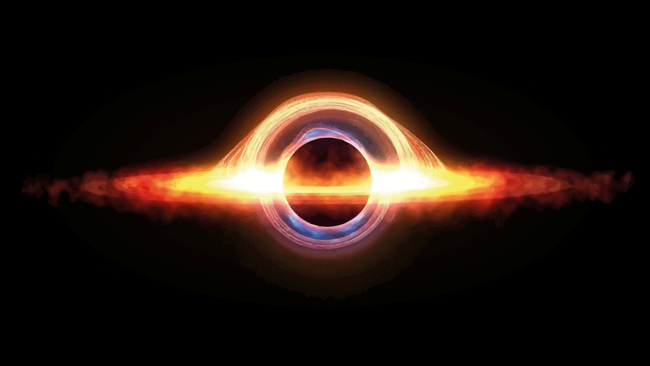
For most of human history, black holes belonged more to the imagination than to science. After all, how could you possibly discover something that doesn’t give off light, can’t be seen through a telescope, and seems to swallow everything that comes too close? The story of how we came to believe in these cosmic phantoms is one of the most unlikely detective tales in astronomy. This is how we discovered Black Holes.
From “Dark Stars” to Einstein’s Equations
The first whispers of black holes go all the way back to the late 1700s. English scientist John Michell and French mathematician Pierre-Simon Laplace wondered: what if a star was so massive that even light couldn’t escape its gravity? They called them “dark stars,” but without any way to detect them, the idea faded into obscurity.
Fast forward to 1915. Albert Einstein unveils his theory of general relativity, a radical new way of understanding gravity. Just a year later, Karl Schwarzschild finds a solution to Einstein’s equations describing an object so dense and compact that space itself folds around it. Mathematically, this was the first black hole—but even Einstein doubted such bizarre objects could exist in nature. For decades, black holes lived mostly in the realm of theory.
The X-Ray Mysteries of the 1960s
Everything changed with the space age. Let’s get into how we discovered black holes. In the 1960s, astronomers began launching detectors above Earth’s atmosphere, which opened up a whole new window on the universe: X-ray astronomy. Among the first puzzling signals was an incredibly bright X-ray source in the constellation Cygnus.
Dubbed Cygnus X-1, it turned out to be a binary system—a normal star orbiting an invisible, incredibly massive companion. Gas was being pulled off the star and heated to millions of degrees as it spiraled inward, glowing fiercely in X-rays. The numbers didn’t add up to a neutron star or anything familiar. The invisible partner seemed to weigh several times more than our Sun but had no surface, no light, no escape. For many astronomers, Cygnus X-1 was the smoking gun: the first strong evidence for a black hole.
Proof in Waves and Pictures
In the following decades, black holes went from controversial theory to accepted reality. By the 1990s, telescopes tracking stars whipping around the center of the Milky Way revealed something invisible yet millions of times heavier than the Sun—what we now know is a supermassive black hole at the heart of our galaxy.
Then came the breakthroughs that made headlines worldwide. In 2015, the LIGO observatory detected gravitational waves—the faint ripples in spacetime predicted by Einstein—caused by two black holes colliding. And in 2019, the Event Horizon Telescope released the first image of a black hole’s shadow in galaxy M87, turning mathematics into something almost tangible.
From Shadows to Reality
Black holes are no longer ghostly abstractions. They are real cosmic players, shaping galaxies, powering quasars, and bending spacetime itself. What began as an 18th-century thought experiment now sits at the center of modern astrophysics.
The irony is that the most invisible objects in the universe have become some of the brightest stars in our scientific imagination.
What’s New?
- The Hunt for the Invisible: How We Discovered Black Holes
- The Mysteries of the Kuiper Belt: Our Solar System’s Forgotten Frontier
- Why Warhammer is the Greatest Sci-Fi Franchise of All Time

- What Order Did The Planets In Our Solar System Form?

- Why Are Some Planets Made of Gas? The Formation of Gas Giants
- Have Astronomers Found a Ninth Planet in Our Solar System?