
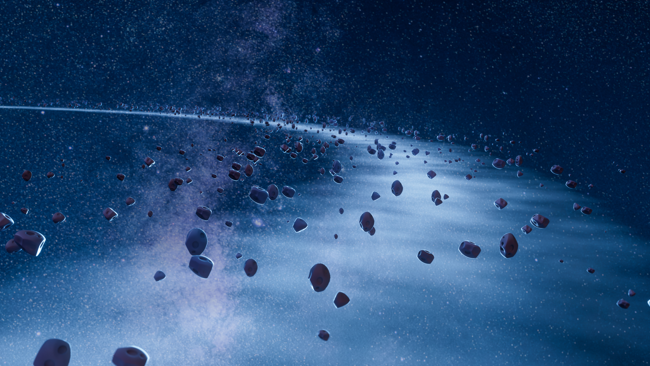
If you could hitch a ride past Neptune and keep going, you’d eventually reach a strange and frozen wilderness: the Kuiper Belt. Think of it as the solar system’s attic—a vast region filled with icy leftovers from the time when the planets were still forming. It stretches billions of kilometers beyond Neptune’s orbit and is home to a bizarre mix of worlds: dwarf planets like Pluto and Makemake, smaller icy bodies, and comets that occasionally make their way toward Earth. The Mysteries of the Kuiper Belt are endless.
New Horizons
What makes the Kuiper Belt so fascinating is how little we actually know about it. We’ve only explored it up close once—when NASA’s New Horizons flew past Pluto in 2015 and then visited the snowman-shaped object Arrokoth in 2019. And those brief encounters raised more questions than answers. Why does tiny, frozen Pluto have an atmosphere that changes with the seasons? How did Arrokoth’s delicate shape survive billions of years without being smashed to pieces? And why are some of these worlds showing hints of geological activity when they should, by all logic, be long dead?
Then there’s the biggest mystery of all: something seems to be tugging on the orbits of the most distant Kuiper Belt objects. Astronomers call it the “Planet Nine” hypothesis—the idea that a hidden world, maybe ten times the mass of Earth, lurks far beyond Neptune. If it exists, it would completely rewrite our picture of the solar system. But so far, no telescope has managed to spot it. In any case, the mysteries of the Kuiper Belt deepen.
The Mysteries of the Kuiper Belt
The Kuiper Belt isn’t just about weird planets and possible hidden giants—it also holds clues to our own origins. Many comets that streak through the night sky are visitors from this region, carrying with them pristine material from the dawn of the solar system. Studying them is like opening a time capsule from 4.6 billion years ago, giving us hints about how Earth, and maybe even life itself, came to be.
For now, though, the Kuiper Belt remains a mystery box at the edge of our cosmic neighborhood. We’ve barely scratched the surface, and every discovery so far suggests that this icy frontier has surprises left to share. Maybe the next great leap in understanding our solar system won’t come from Mars or the Moon, but from the frozen worlds waiting patiently in the dark beyond Neptune.
What’s New?
- The Hunt for the Invisible: How We Discovered Black Holes
- The Mysteries of the Kuiper Belt: Our Solar System’s Forgotten Frontier
- Why Warhammer is the Greatest Sci-Fi Franchise of All Time

- What Order Did The Planets In Our Solar System Form?

- Why Are Some Planets Made of Gas? The Formation of Gas Giants
- Have Astronomers Found a Ninth Planet in Our Solar System?
